


For years, brands had to pick a lane. Television delivered scale and told the brand story, while digital delivered proof of what that spend actually did, usually at a much smaller scale. Connected TV is where that trade-off stops applying, not because the screen changed, but because CTV measurement is finally catching up to what digital advertising could always prove.
What follows looks at how CTV picked up digital's capabilities, how close the remaining gaps are to closing, and what that means for performance marketers today.
The Path From Web to Mobile to CTV Was Always About Measurement
Digital media has expanded in a fairly predictable order. A new channel earns its share of the budget only once it can show, with some confidence, what that budget is producing. That is what happened with the web, once cookies and click tracking made attribution possible for the first time. It is what happened with mobile too, once device identifiers and mobile measurement partners gave marketers the same kind of visibility on a smaller screen.
Connected TV is going through that same process now, just later than expected. It was never really the size of the screen holding advertisers back. What held them back was the fact that television could not offer the same proof digital could, and that is starting to change. U.S. CTV ad spending is projected to reach approximately $37.95 billion in 2026, a 14.5 percent increase over the prior year, according to eMarketer's December 2025 forecast. Looking further out, the same research house expects CTV ad spend to overtake traditional TV advertising by 2028, climbing from $32.45 billion in 2025 to $45.96 billion.
It helps to think about why search and social succeeded the way they did. They paired reach with a fast feedback loop, so a marketer could see what was working and adjust quickly. Television, historically, only offered the reach half of that equation. What has changed recently is not how people watch television, since large audiences have been watching on connected devices for years already. What has changed is the layer of infrastructure now sitting behind those impressions.
The Digital Capabilities CTV Has Adopted
This shift shows up clearly in how much money is now committed to CTV. Connected TV is on pace to surpass linear TV in prime-time upfront ad spending for the first time this year, according to eMarketer's analysis at its 2026 Ad Buyer Strategies Summit. What is changing is not just the size of that commitment, but the mechanics behind it. Four capabilities that digital advertisers have taken for granted for over a decade are increasingly showing up in how CTV itself gets bought, targeted, and measured.
- Programmatic and real-time bidding. More programmatic CTV inventory now moves through the same auction mechanics used in mobile and display, instead of being locked into negotiated, upfront-only deals.
- Audience-based targeting. Once that inventory is available programmatically, buyers can build CTV audiences from behavioral and contextual signals, not just from the demographics tied to a given program.
- Cross-device attribution frameworks. Knowing who is being targeted only matters if it can be measured, and new CTV attribution standards are starting to connect a CTV impression to what happens afterward on mobile and desktop, addressing a disconnect that used to make CTV feel separate from the rest of the funnel.
- Frequency management across screens. With attribution in place, advertisers can also cap and coordinate how often someone sees an ad across every device in a household, instead of treating CTV as its own isolated buy.
None of this is new territory for performance marketers. What is new is seeing it inside a channel that, until recently, was mostly reserved for brand spend.
The Remaining Gaps in CTV Measurement Are Closing
The friction that is left is real, but it is narrowing. Streaming reached 48.5 percent of total U.S. TV watch time in June 2026, ahead of broadcast at 19.8 percent and cable at roughly 19.5 percent, according to Nielsen's The Gauge, a shift the industry is actively building measurement infrastructure to match.
The IAB's Standardized Measurement Guide for CTV, published in December 2025, is part of that effort: an attempt to align the fragmented standards that have historically made a metric like viewability or reach mean different things on different platforms. A related IAB Europe survey found that 30 percent of advertisers and publishers already report full visibility into where their CTV ads run, with standardization work underway to close that gap for the rest.
The choice between reach and proof is disappearing. What is left is closing the last of the measurement gap, and that is happening faster than most media plans assume.
For a marketer used to the level of detail mobile and web campaigns provide, this gap is worth watching closely. It is real, but it is one that is actively shrinking, not one that is fixed in place.
Incrementality: Closing the Last Gap Between Reach and Proof
None of this means marketers need to wait for the industry to agree on a single standard before they can act. The real question is which measurement approach to lean on while that standard is still forming, and the three most common options come with very different trade-offs in a cross-screen environment.
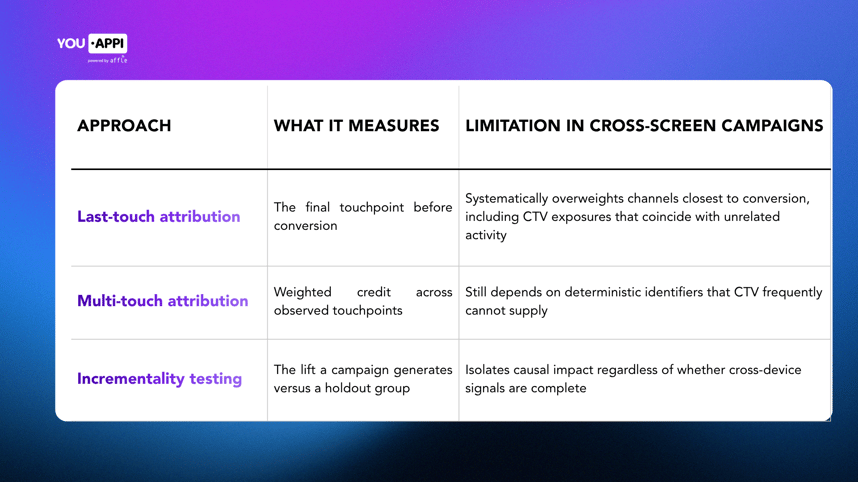
One way around the identifier problem is incrementality testing, which compares an exposed group to a similar group that was not exposed, rather than trying to trace every individual touchpoint. Most incrementality frameworks work the same way at a basic level: hold out a small control group, run the campaign against everyone else, and measure the lift between the two, then scale that lift to estimate the campaign's real contribution. For a closer look at how this discipline applies to mobile and cross-screen retargeting specifically, see how incrementality testing separates real lift from attribution correlation.
This is also where YouAppi's approach fits in, as one example rather than the starting point. Its incrementality methodology keeps an always-on control group of 10 percent of users while the other 90 percent are exposed, so lift is measured continuously instead of in one-off tests. Paired with cross-device attribution, that is what lets a brand run CTV for reach and still prove what it delivered, in the same terms as a mobile campaign.
What This Means for Performance Marketing Teams
All of this changes how a CTV line item should be judged, not just how it gets bought in the first place. Marketers who already run mobile retargeting have most of the playbook they need already. It is mostly a matter of applying it to a newer surface.
- Treat CTV as a performance channel from day one. Apply the same testing rigor used for mobile UA and retargeting, rather than putting optimization off until later.
- Build holdout groups into every CTV flight. Incrementality is still the most reliable way to prove impact while identifier-based attribution keeps maturing.
- Connect CTV exposure data to mobile and web behavior, even when match rates are far from perfect. Partial visibility still beats treating CTV as a black box, and it is worth understanding exactly how much reach CTV adds on top of mobile campaigns before writing off the connection.
- Budget for measurement, not just media. Signal fragmentation is something each buyer can actively manage today, using tools like incrementality testing, rather than something to wait out.
Measurement Is What Makes CTV the Bridge
CTV did not turn into a bridge between offline and online media by becoming less like television. It became one by becoming more like digital, in the one dimension that has always decided where ad budgets go: what can actually be measured and proven. Brands no longer have to choose between the reach television offers and the proof digital demands. Increasingly, they get both from the same line item.
The channels that pick up the next wave of CTV investment will not necessarily be the ones reaching the biggest audiences. They will be the ones that can answer, with the same confidence marketers already expect from mobile and web, what a given impression actually did. That is the real line between offline and online media, not screen size, and it is closing faster than most media plans currently account for.
Marketers weighing how to prove CTV's contribution can download Singular's 2026 CTV Growth Playbook, which includes YouAppi's perspective on connecting CTV exposure to mobile outcomes.