



Many gaming organizations default to a seven-day inactivity period simply out of habit rather than data-driven validation. The logic feels reasonable: give new players space, let them settle, wait before spending a retargeting budget. But that logic was designed for a market that no longer exists.
In the high-stakes battle for player attention, the window for action begins almost immediately after installation. Choosing an incorrect inactivity threshold isn't a sign of patience; it is a failure of speed.
What an Inactivity Window Actually Controls
An inactivity window establishes the duration a user must remain idle before qualifying for re-engagement. While it may appear to be a trivial configuration, its impact is profound.
The challenge lies in balancing two conflicting metrics: ROAS and segment size. A window that is too brief risks wasting capital on users who would have returned organically, whereas a window that is too extensive allows users to churn to competitors. This guide explores how to navigate that critical tradeoff.
Why the First Few Days Matter Most for Retargeting
The day 7 convention traces its origins to user acquisition rather than re-engagement strategy. It operates on the assumption that new users require a full week to organically evaluate a title, an assumption that retention data consistently contradicts.
According to GameAnalytics, average Day 7 retention for mobile games in 2024 sat at approximately 8%, meaning that by the time most re-engagement campaigns activate, 92% of users have already reached a definitive conclusion about the product. AppsFlyer's 2024 State of Gaming App Marketing report further substantiates this: the first in-app purchase on iOS occurs around Day 2 for roughly a quarter of all buyers, with an additional 17% converting by Day 3.
The monetization window is not a gradual slope. It opens within the first 72 hours and narrows quickly thereafter.
Drop-off rates peak around days 3 and 4, meaning that teams waiting until day 7 are retargeting an audience that has largely already disengaged. The financial consequences of that delay are compounding: CPI for casual gaming apps doubled between 2022–23 and 2023–24, rising from $0.98 to $2.17 per install. As acquisition costs escalate, the tolerance for delayed re-engagement narrows proportionally.
The Tradeoff: Audience Size vs. ROAS
Extended windows yield larger audiences; tighter windows yield higher-quality ones. The distinction carries significant implications for campaign performance across the full spectrum of configurations:
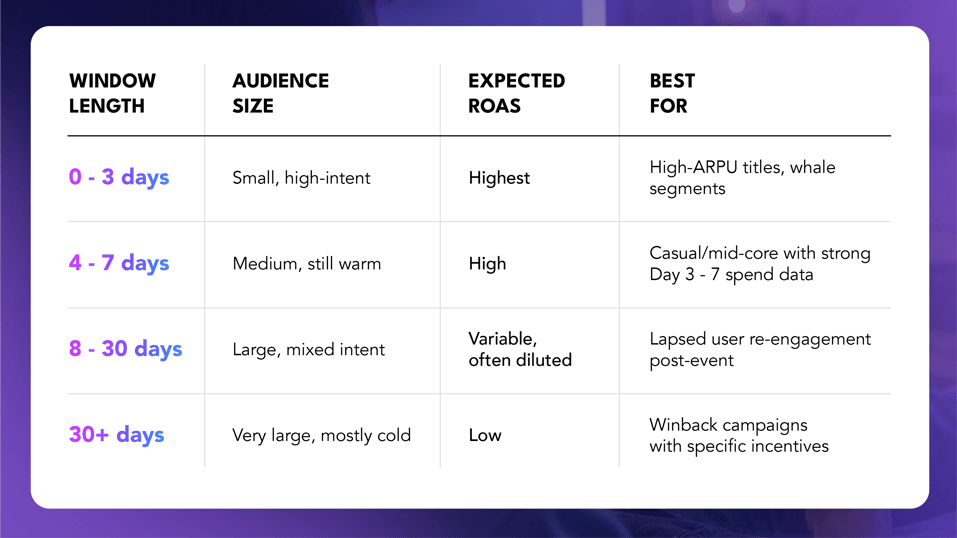
Shorter windows target users who remain within the active monetization arc, prior to forming a definitive view of the product. Longer windows engage users who have already made that determination, and reversing it demands considerably greater investment.
One important caveat for shorter windows: the more precise the segment, the greater the risk of attributing organic re-engagement to paid activity. Incrementality testing, specifically deploying a holdout group that receives no re-engagement ads, is particularly critical when operating with windows under 7 days. Without a controlled baseline, strong ROAS figures can be structurally misleading.
Ran Zukerman, Senior VP Product Performance, YouAppi, put it plainly:
"Incrementality testing is not optional when building a re-engagement strategy. Running a controlled holdout group will give you additional important data points to measure whether your campaigns are driving genuine lift or simply claiming credit for users who would have returned on their own. This is especially true for shorter inactivity windows, where the overlap with organic re-engagement is higher."
Setting Your Window by Game Type
There is no universally optimal configuration, but the monetization model provides the most reliable foundation for calibrating window length.
- Casual games (IAA-heavy): These titles are sustained by session frequency rather than transactional spend, making a 3–5 day window appropriate. Casual players engage in short, habitual sessions, and an absence of more than a few days constitutes a meaningful disengagement signal. AppsFlyer's monetization data indicates that hybrid casual games on iOS can generate up to 55% of total revenue by Day 7, positioning early re-engagement as a direct revenue lever rather than a retention metric.
- Mid-core games (IAP-dominant): These players exhibit longer conversion timelines but higher revenue potential per transaction. A 5–7 day window captures users who remain within the natural consideration phase. Compressing the window risks disrupting organic conversion, while extending it risks losing users to attrition entirely.
- High-ARPU / whale-focused titles: In this segment, window length is secondary to segmentation precision. A 0–3 day window scoped to users who exhibited early purchase intent (advancing through key progression milestones, viewing an IAP offer without converting) will consistently outperform a broader 14-day window targeting all inactive users.
- Seasonal or event-driven games: Live events generate organic reactivation conditions. A parallel 30+ day winback window, aligned to a new event launch and supported by creative that surfaces missed content, can be effective in this context. This should be structured as a distinct campaign with independent measurement to avoid conflating results with standard re-engagement activity.
How to Test and Refine Over Time
A window configuration is a hypothesis that requires empirical validation rather than a fixed parameter to be set and forgotten.
The most reliable starting point is a controlled A/B test: two concurrent campaigns targeting the same segment, differentiated only by window length, one at 3 days and one at 7 days. Measuring ROAS at Day 7, Day 14, and Day 30 post-re-engagement will yield title-specific performance data that no industry benchmark can replicate.
Beyond top-line ROAS, the following signals warrant structured tracking:
- Incrementality: A holdout group is the only methodologically sound mechanism for determining whether retargeted users would have returned without intervention. Without one, organic re-engagement is routinely attributed to paid spend, inflating reported returns.
- Revenue per re-engaged user vs. organic: Retargeted users generate 37% more revenue events in the first 30 days compared to newly acquired users.
- Day 1 vs. Day 7 retention of re-engaged users: A sharp decline in retention between Day 1 and Day 7 indicates that the active segment includes users who lacked genuine re-engagement intent. The appropriate response is to tighten the window or refine audience criteria.
Window configurations should not be adjusted too frequently. Operating with a defined window for a full month before making any changes, then measuring incrementality and testing a new configuration, produces cleaner data and more reliable conclusions.
Re-engagement is an always-on strategy. Building it in structured steps, with proper measurement at each stage, is what allows advertisers to arrive at a setup that delivers consistent value over time.
The Variable That Matters More Than the Window
Window length determines when to initiate re-engagement. Audience segmentation determines who receives it. Conflating the two, or neglecting the latter, significantly undermines campaign efficiency.
A user who completed a purchase within their first three days before going quiet represents an entirely different re-engagement opportunity than one who installed, launched the app twice, and disengaged without meaningful interaction. Applying a uniform creative strategy, bid structure, and window to both segments means that high-value users are competing for the same budget allocation as users with a substantially lower probability of conversion.
YouAppi's audience segmentation operates at the individual user level, constructing re-engagement eligibility from behavioral signals that extend beyond recency: purchase history, session depth, content progression, and in-app event patterns. The result is a budget allocation that concentrates spend where performance is structurally supported. A well-scoped window combined with precise segmentation consistently outperforms a broad window applied without audience differentiation.
Start Here
Inactivity windows represent a narrow configuration with outsized consequences for ROAS. The optimal setting is not found in industry defaults. It is derived from the specific behavioral patterns of your own user base. Begin with a 3–5 day window, run a controlled holdout test against a broader configuration, and allow performance data to drive iteration from there.
To understand how YouAppi structures inactivity window strategy and audience segmentation for gaming clients, request a call with our team.