


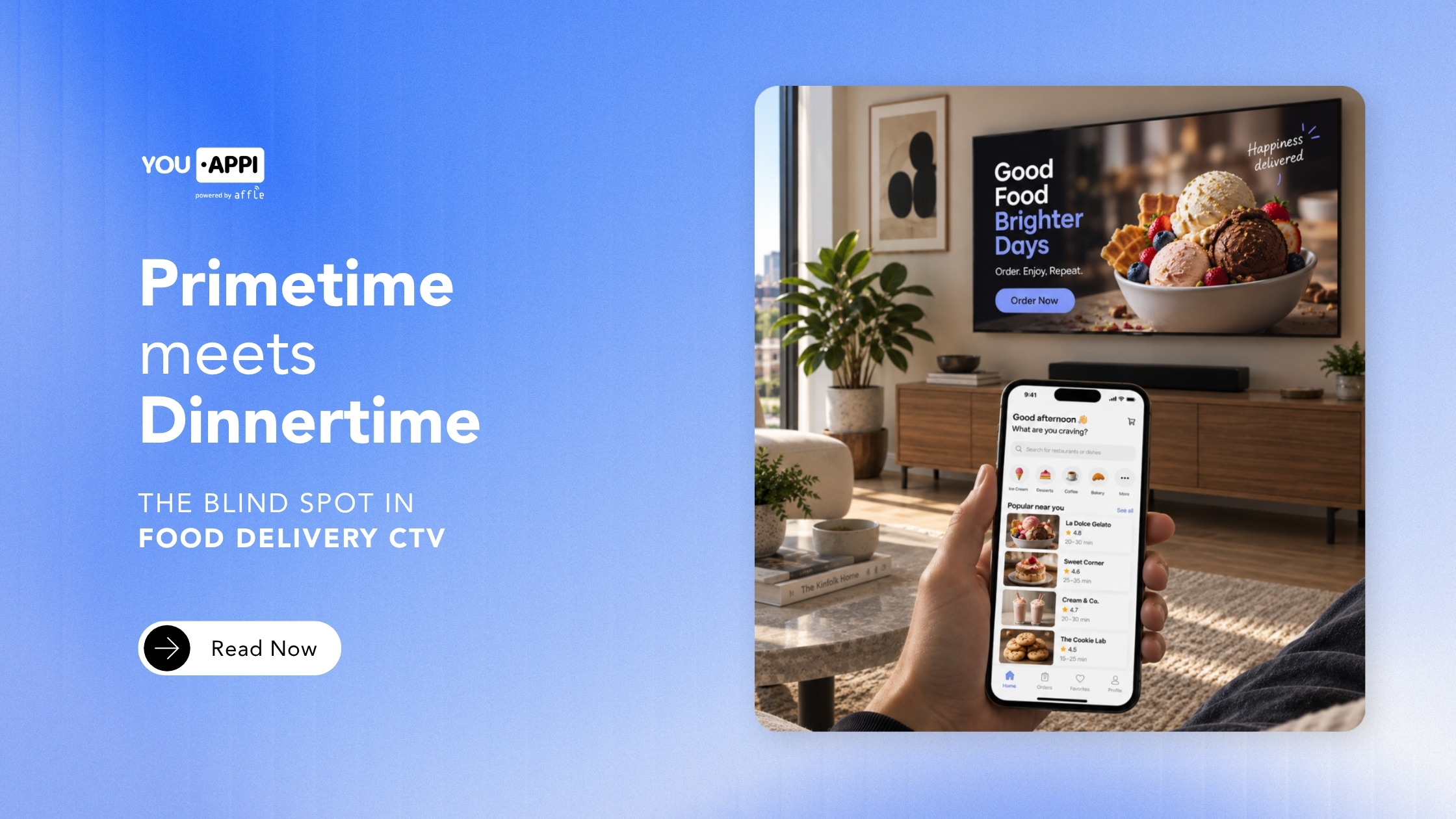
There is a pattern in the timing of streaming and food delivery that looks too clean to be a coincidence. Food delivery teams build media plans around meal windows, while CTV teams build theirs around content windows. Almost nobody treats those two schedules as the same thing, even though the data increasingly says they are.
Streaming now accounts for roughly half of all U.S. primetime viewing, landing squarely inside the same three-hour window when most dinner orders get placed. Second-screen behavior during that window looks less like distraction and more like active shopping, and food delivery sits closer to the center of it than most categories would guess.
This piece walks through what that overlap looks like in the data, and what it means for treating CTV as a performance channel rather than a brand-only buy.
The Three-Hour Window: Where Streaming Primetime Meets the Dinner Order
When People Are Actually Watching
Nielsen's Gauge data puts streaming at 46 to 47.5 percent of all U.S. primetime television viewing through late 2025 and into 2026, with the effective window opening around 7 p.m. and running well past the traditional 11 p.m. broadcast cutoff. That is a wider, later window than most CTV buyers are still planning against, which already matters before a single food delivery number enters the picture.
When People Are Actually Ordering
Line that up against the ordering side. A 2026 ordering behavior report placed the strongest dinner period between 5:30 and 8:30 p.m., and DoorDash has reported 6 p.m. as its single most common order time. Put the two data sets side by side and there is no real gap between them, just one continuous three-hour block where a screen is on and a decision about dinner is being made.
Why the Overlap Goes Unplanned
The interesting part is not that the windows overlap. It is that almost nobody plans media as if they do. Streaming inventory and food delivery ordering data live in different systems, tracked by different teams, describing what is functionally the same audience at the same hour.
Two more details sharpen the picture. Fifty-eight percent of consumers now choose ad-supported streaming over ad-free tiers, so a growing share of that dinner-hour audience is watching on inventory that carries commercial breaks at all, and Uber's own driver guidance flags a further evening surge on Fridays and Saturdays that tracks closely with weekend streaming peaks.
Both point the same direction: the overlap is not a weekday quirk, it is close to the default.
The Second Screen Was Never Just Scrolling
That overlap only matters if the people on that second screen are doing more than half-watching while they scroll. It does not look that way: 78 percent of viewers use a second device while watching TV, and searching for products or shopping online are already among the most common things they do on it.
That is the part worth sitting with. A second screen open during a show is not competing with the TV for attention, it is often extending the moment into an actual purchase. An Advocado survey found that half of viewers have bought a product or service based on a TV commercial, and when they act, the paths are fairly concentrated:
- Exploring the brand's app or website (34 percent)
- Searching on Google or another search engine (30 percent)
- Going straight to an ecommerce site (19 percent)
None of those paths take more than a few taps. For a category built on an app that is usually already installed, that short a path is close to ideal.
Age sharpens the pattern further. Gen Z shows the highest multiscreen engagement of any generation, with 91 percent using social media while watching TV, and a stronger preference for personalized, interactive ad formats than older viewers. For a category whose ordering base already skews young, that is not a side note. It is close to describing the core customer.
Who Is Actually Ordering From the Couch
Food delivery fits naturally inside that behavior. It is a habitual, repeat-purchase category, and habitual purchases are exactly what a habitual viewing pattern like second-screening tends to reinforce.
Technomic data backs up the habitual part directly. The heaviest food delivery users skew toward 30 to 44 year olds with household incomes under $50,000, ordering more than 18 times a year and spending close to $650 in the process, a frequency profile that looks closer to a subscription habit than an occasional treat.
Someone who reaches for their phone during a show without thinking about it is also the kind of person who reaches for an already-installed ordering app without thinking too hard about it either. The two habits run on the same kind of autopilot, which is part of why the timing overlap matters more for this category than for one built on considered, occasional purchases.
Dinnertime Is for Re-Engagement, Not New Installs
None of this is really about winning new customers. A viewer opening a food delivery app during the dinner hour rarely looks like someone deciding whether to install one for the first time. More often, it looks like this:
- Someone who already has an account and has ordered before
- Someone deciding whether tonight is one of those nights, not whether the app is worth trying
- Someone whose decision window is measured in minutes, not days
That distinction changes what the ad should be doing. A new-install push is competing with dozens of other apps for a moment when the viewer has no real urgency to decide anything. A win-back nudge aimed at someone who has ordered before, arriving while they are already weighing options at 7:15 p.m., is competing with almost nothing at all.
CTV Deserves a Performance Role, Not Just a Menu Reel
Food and beverage CTV creative leans hard on visual appeal, and there is a real reason for that: food looks better on a big screen, and regional reach still matters for local promotions. None of that stops being true because of the timing data above.
What the timing data adds is a second layer worth building on top of it. The three-hour overlap established earlier means a meaningful share of that reach is already landing on customers, mid-decision, at that exact hour. Pairing that reach with a retargeting layer, instead of treating reach as the whole strategy, is where the opening sits for food delivery specifically.
.png?width=998&height=562&name=Tables%20-%20YA%20(2).png)
Neither column replaces the other. The first is still what earns CTV its budget. The second is what turns that budget into something closer to a full-funnel channel for a category built on repeat, habitual purchases.
Sequential messaging, a CTV exposure followed by a retargeting touch, is already standard practice in categories like travel and ecommerce. Food delivery appears to be adopting it more slowly, which may have less to do with the channel itself and more with how recently CTV budgets have existed at real scale for the category in the first place.
For a fuller breakdown of how CTV and mobile can work as one system rather than two, the CTV & Mobile 2026 Growth Guide is a reasonable next step.
The Sequencing Logic Behind the Timing
Everything up to this point makes the case for why the timing matters. Turning that into a working campaign does not need new measurement, just a different sequencing logic:
- CTV exposure timed to the early streaming block, roughly 7 to 8 p.m., while the dinner decision is still open
- Mobile retargeting timed to land inside that same ordering hour, rather than the next morning's push notification
- Creative that reflects the daypart: dinner offers and menu items instead of generic app-open prompts
- Frequency capped against a single cross-screen user record, not two campaigns running blind to each other
The mechanism already exists in mobile-only retargeting. What changes is the timing logic behind when the second touch actually fires.
Where the Order Window Meets the Ad Buy
The overlap between streaming primetime and dinner ordering does not read like a niche behavioral quirk. It looks more like a scheduling gap that a lot of food delivery media plans have not caught up to yet, built as they still are around channels that were not designed to talk to each other.
Platforms built for real-time audience segmentation and dynamic creative optimization, YouAppi among them, exist precisely for this kind of cross-screen sequencing. Treating the streaming window and the ordering window as one signal, instead of two separate campaigns, is where the opportunity actually sits.
Food delivery brands running mobile retargeting without a CTV layer are already reaching half of this window. The CTV & Mobile 2026 Growth Guide covers what the other half looks like.
The 2026 CTV Growth Playbook, built together with Singular, covers the complete regional benchmark set, the full ninety-day framework, and the attribution setup that determines whether any of these numbers get read correctly.