


.png)
The "paying twice" objection surfaces in many retargeting conversations, and it rests on a specific misconception: that a lapsed user who already converted is the same investment as a new install. After fifteen years of mobile retargeting, the pattern YouAppi observes across campaigns is consistent: lapsed users in many cases outperform newly acquired cohorts on engagement, revenue, and retention.
This article examines why, and what drives the most LTV from the users you retarget.
Lapsed Users Carry Data That New Installs Cannot
The most useful place to start is with what a lapsed user actually brings to a campaign. Unlike a new install, who arrives with no behavioral history, a lapsed user has left a detailed record: engagement with core features, in-app events, and a documented churn point that reveals exactly where the experience broke down.
Their purchase history shows whether they ever spent money, and their session patterns show how far along the disengagement curve they are. None of that exists in a new prospect's profile, and all of it changes what re-engagement spend can actually do.
Adjust's April 2025 analysis of 140 apps, covering more than 500 retargeting campaigns against nearly 9,000 UA campaigns, put numbers to that difference:
- Engagement rate: Retargeted users generated 152% more in-app events per user than newly acquired cohorts in the first 30 days. Re-engaged users bypass the onboarding friction that new installs face.
- Revenue events: Retargeted users triggered 37% more revenue events in the first 30 days post-reinstall, a gap that widened to 49% by Day 7.
- Retention: Retargeted users retained at a 5% higher rate on Day 1, a gap that held through Day 7 before narrowing in subsequent weeks.
The same study puts the cost of acquiring a paying user from cold acquisition at $100 or more, which is what makes those performance differences matter in a budget conversation.
The Economics That Reframe the Comparison
That $100 figure only makes sense alongside the structural reality of new user acquisition within mobile apps. In gaming, one of the most competitive verticals for mobile UA, the numbers are especially stark: AppsFlyer's uninstall benchmarks show that gaming apps lose more than 50% of their installed base within 30 days on Android, the majority before any purchase event occurs. GameAnalytics' 2025 Mobile Gaming Benchmarks, analyzing 11,600 apps across 9 regions and 16 genres, found that 75% of mobile games retain fewer than 3% of players by Day 28.
Those numbers point to the same conclusion: most lapsed users are not quietly planning to come back on their own. Re-engagement spend targets the users who have left and are not returning organically, specifically those with documented purchase intent. That is a different audience, a different cost structure, and a different calculation than the "paying twice" framing implies.
Global app remarketing spend reached $31.3 billion in 2025, up 37% year over year, with remarketing's share of total app marketing budgets rising from 25% to 29%. The teams driving that shift are the ones who ran the full cost-per-outcome math and found that re-engagement delivers results that cold acquisition cannot match at the same price.
The Lapsed Users Owned Channels Cannot Reach
The owned channel version of the paying twice objection argues that push notifications, email, and in-app messaging already exist to reach lapsed users at no additional media cost. The problem with that reasoning is the same as the one with the broader objection: it assumes the owned channel audience and the retargeting audience are the same population.
They are not. A user who has uninstalled the app cannot receive a push notification, and a user who stopped opening emails months ago is not meaningfully reachable through CRM regardless of list segmentation. The lapsed users with documented purchase intent, those most worth re-engaging, have typically disengaged from owned touchpoints before a retargeting campaign would target them.
Paid retargeting reaches those users across open web and in-app inventory, where they remain active even after disengaging from the app itself. That is not a redundant channel alongside push and email. It is the channel that covers the gap owned programs structurally cannot.
How Audience-Level Scoring Makes Re-Engagement Defensible
Given that most lapsed users have exited permanently, the targeting question becomes the most important one: which users in the lapsed pool actually need a paid push to come back, and which were going to return anyway? YouAppi's platform is built to answer that question for every campaign, scoring the lapsed audience in real time against behavioral signals that separate the two:
- Real-time audience segmentation built on in-app event history, session decay, prior purchase events, and churn prediction signals. Campaigns bid only against users where paid intervention actually changes the outcome.
- Ghost bidding methodology that runs always-on control groups, measuring incremental lift against organic return rates continuously rather than through one-time tests.
- Dynamic creative optimization (DCO) that matches re-engagement messaging to each user's specific churn signal, rather than sending a generic prompt to the entire lapsed pool.
Building the Incrementality Framework That Proves It
Those capabilities work best when the measurement structure around the campaign is set up to actually prove the lift. Three conditions determine whether retargeting spend is genuinely incremental:
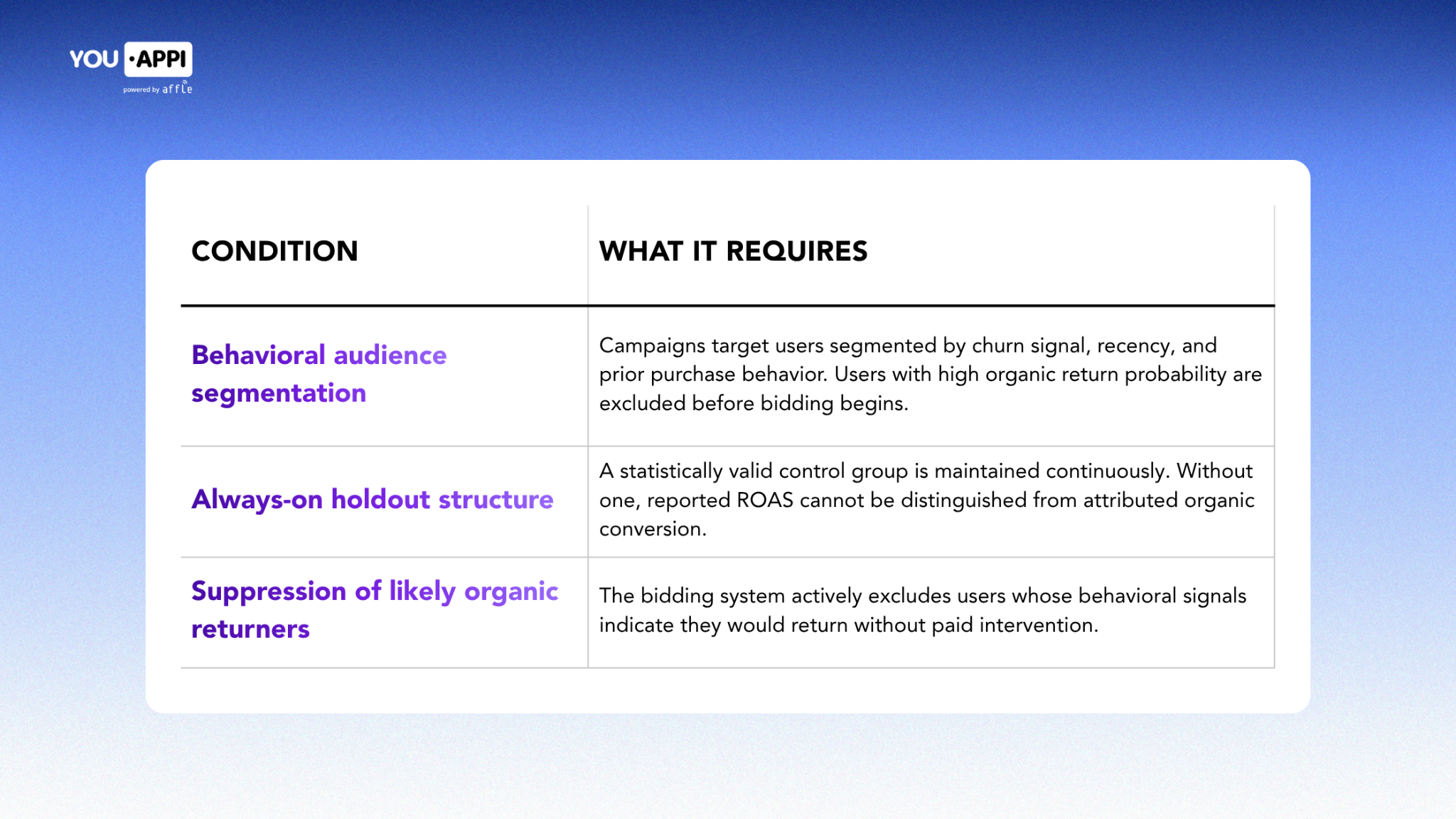
When these conditions are in place, reported ROAS reflects real incremental lift. When they are not, the "paying twice" objection has a point.
Re-Engagement Results That Answer the Paying-Twice Objection
Lapsed users carry behavioral data that no new install has, they convert faster, generate more revenue events, and cost less to bring back to a meaningful action than cold acquisition costs to produce one in the first place. The organic return population across mobile apps is small enough that most of the users in the lapsed pool are not coming back without a push, which means re-engagement spend is not doubling down on users who were already on their way back.
It is targeting the ones who were not.
When the measurement architecture is in place to prove that distinction, the "paying twice" objection answers itself. YouAppi has been running retargeting campaigns for fifteen years with exactly that evidence base behind every decision. If you want to see what it looks like for your user base, the results and a demo are a good place to start.