



Rewards apps are built on the foundation that giving users a reason to earn will keep them engaged, yet inactive users accumulate at the same rate as in any other app category. That gap is not a flaw in the reward process itself; it is a signal that a more precise layer of engagement needs to take over where the incentive alone leaves off.
Loyalty platforms retain something most other verticals have lost: a first-party record of what users actually buy, captured at the moment of purchase rather than inferred afterward. That record is what turns winning them back into a matter of precision, not persuasion, provided it gets activated before disengagement becomes permanent.
Why the Reward Alone Stops Working
The loyalty category is not short on investment. The global loyalty management market is growing at a 14.62 percent compound annual rate expected through 2031. That spending assumes reward mechanics alone accomplish retention, but consumers enroll in far more programs than they ever actively use, and enrollment is not engagement.
The reason is that reward-based engagement decays on a predictable curve. Early redemptions feel valuable because the effort to earn them is fresh against the payoff. As the program matures, the reward is no longer reinforcing the behavior, only habit is, and habit breaks against a competing program or a better rate elsewhere.
Over-messaging and irrelevance speed up that decay. A program with a fully functioning reward system can still lose users it should be able to keep, and the reward alone will not explain why. That is a re-engagement problem, not a reason to redesign the reward or the reward process.
The Signal Loyalty Apps Own That Other Verticals Lost
Addressing this challenge requires identifying wandering users and understanding their motivations, an area where rewards platforms possess an unmatched edge. Most re-engagement strategies still depend on a device-level identifier whose availability keeps narrowing, and verticals built around that identifier to rebuild lapsed audiences have had to adapt.
Fortunately, loyalty applications never relied on device identifiers for their most vital data. Churn-predicting behaviors, like a paused redemption or an interrupted purchasing habit, are recorded the exact moment a receipt is scanned or a reward is redeemed, distinguished by four primary signal types.
- Receipt scans. A verified, timestamped record of an actual purchase, not a modeled estimate from probabilistic matching.
- Redemption behavior. The moment a user redeems, or stalls just before, marks a precise point in the funnel a campaign can target directly.
- Purchase category and frequency. Apps built on receipts retain granular behavioral data long after device identifiers become unavailable elsewhere.
- App and game engagement. A completed install, tutorial, or gameplay milestone creates the same kind of verified, timestamped action as a receipt scan, without requiring a purchase at all.
These signals are collected directly inside the app, using identifiers like the IDFV that remain available regardless of ATT consent status. When that data needs to activate retargeting in other apps, matching does not depend on a consented device identifier either, it resolves probabilistically through contextual and behavioral signals instead. That signal exists because the user already trusted the app enough to transact inside it, a stronger base for a win-back audience than any inferred lookalike.
For a growth team allocating budget, that changes the math. Most verticals are re-engaging users against an addressable pool that keeps shrinking as third-party identifiers become less reliable. In loyalty, the win-back audience is defined by first-party behavior the app already owns and keeps collecting with every scan, an asset that renews itself independent of any single identifier. That durability is what makes reactivation one of the more defensible budget lines a rewards app can fund right now.
From Behavioral Signal to Predictive Activation
Possessing the signal is merely the foundation; unprocessed transaction data lacks the inherent power to recover a single user. The utility of that data lies in its conversion into predictive intelligence: identifying imminent churn risks, ranking dormant users by their likelihood of reactivation, and determining the precise value of a re-engagement bid within a real-time environment.
This is where the reward stops being the retention strategy and becomes the signal that powers one. YouAppi's retargeting platform reads postback events such as receipt scans, redemption timing, purchase frequency, and app or game engagement milestones to feed predictive scoring and automated bidding that rank users by return likelihood.
What makes that prediction precise is the reliance on actual purchase behavior rather than device-level proxies. A user who has simply paused between purchase cycles bears little resemblance to one who has genuinely churned, and postback event history distinguishes between the two before a single impression is ever served.
Precision of this kind carries value only insofar as the campaign can demonstrate its own effect. A user who reopens the app during a campaign does not, on its own, constitute proof that the campaign produced the return, since a portion of those users would have resumed activity regardless.
Isolating the true incremental lift requires withholding a control group and measuring its performance against the exposed audience, a comparison that distinguishes a reactivation figure that appears successful from one that is demonstrably so.
Proof in Practice: How Fetch Reactivated Dormant Reward Users
Fetch, America's rewards app, spans both receipt-based rewards and in-app game engagement, and illustrates what this approach produces when the underlying signal is rich and the segmentation applied to it is precise. Fetch captures more than USD 179 billion in consumer transactions annually (YouAppi x Fetch case study).
In partnership with YouAppi, deploying real-time audiences, recency-based segmentation, and deep-funnel optimization, Fetch executed distinct campaigns against distinct points along the lapse curve.
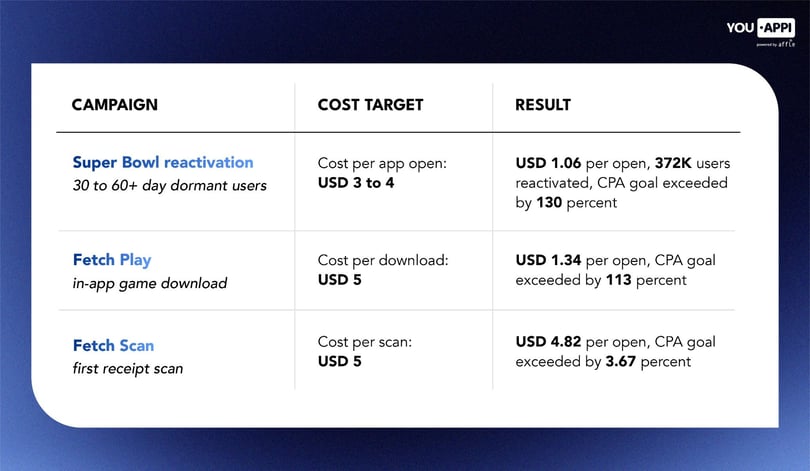
Each outcome resulted from matching the audience to a specific behavioral state, rather than applying a single recency window across every user who had gone quiet. The dormant Super Bowl segment required a stronger pull tied to a live event, while the first-scan segment required only a nudge to complete an action already begun but never finished.
Start With the Signal You Already Own
The applications that are most exposed to signal loss, spent years renting addressability from an identifier they never controlled. Rewards apps possess something considerably more durable: a consented, verified record of what their users actually purchase. The relevant question is not whether that data exists, but whether it is being activated to reach lapsed users before the gap becomes irreversible.
The full Fetch case study explores how predictive segmentation, automated bidding, and behavioral signals combined to reactivate dormant users at scale. Read it here for the segmentation strategy in detail, or talk to a YouAppi retargeting specialist to map the same approach onto your own dormant users.