


Each February, the United States brings together its most massive television audience of the year. In contrast, the quadrennial World Cup establishes a completely different rhythm: rather than a single concentrated peak, it delivers a sequence of waves distributed across every time zone over the course of a month.
For performance marketers, discovering what kind of mobile engagement window each event creates is far more important than determining which one is larger, along with ensuring that a campaign is properly engineered to tap into it.
Contrasting Patterns of Audience Attention
Designing a strategy for these major sports events requires navigating two entirely distinct audience structures: one compresses intense attention into a single evening, while the other spreads massive engagement across several weeks.
The Super Bowl serves as the definitive model for a concentrated domestic event. According to data, Super Bowl LX attracted an average of 125.6 million viewers in the United States, with an audience peak of 137.8 million during the second quarter. This immense viewer base materializes for a single four-hour broadcast on one night within one nation, creating an engagement pattern that is highly intense, localized, and predictable.
In contrast, the World Cup unfolds with an entirely different rhythm and scale. FIFA reported that around five billion people engaged with the 2022 tournament across multiple platforms and devices. The final game reached an estimated 1.42 billion people, while individual matches maintained an average of 175 million viewers. Because FIFA tracks digital, out-of-home, and in-home reach across a six-week tournament window, these metrics vary from Nielsen’s average-minute methodology. Nevertheless, the core takeaway for planning remains highly instructive: one model isolates attention into a vertical peak, whereas the other distributes it as sustained volume over dozens of matchdays.
This structural divergence yields direct operational consequences for campaign execution:
- A single-night peak requires absolute readiness and pre-positioning, as the brief broadcast window leaves no room to recover a missed opportunity.
- A multi-week tournament demands ongoing adaptability, as audience dynamics shift constantly when teams advance, exit, and redirect attention across regions.
Mapping Mobile Engagement Concentrations per Event
Broadcasters capture only a fraction of total audience attention, as the second screen serves as the primary driver of measurable consumer behavior. Across both sports events, mobile devices absorb all peripheral engagement, from real-time score updates and social media reactions to in-play wagering and commerce activities during commercial intermissions.
The sports betting sector exhibits the most pronounced growth. For example, Sensor Tower noted an 83 percent surge in United States sportsbook app downloads during the opening week of the 2022 World Cup, highlighted by a 104 percent increase for DraftKings and a 163 percent jump for FanDuel, alongside a 17 percent lift in daily active users.
Real-time data from the 2026 tournament reveals an identical trajectory: Apptopia documented a 35 percent year-over-year increase in combined user sessions across prediction market and sportsbook applications during the first half of June.
This operational pattern extends far beyond betting and aligns precisely with the timeline of the match itself:
- Pre-game: Fans look to live streaming and sports news platforms to confirm access and catch up on team updates.
- Halftime: This 15-minute broadcast intermission forms the densest discovery window, with social media, food delivery, and mobile commerce apps receiving intense user focus.
- Late-game and Post-match: High-intent sessions peak as match outcomes materialize and discussions shift to mobile channels.
For advertisers deploying paid media around these events, the core takeaway is that this surge is structured rather than random. Pinpointing which category activates at any given moment differentiates intentional investments in genuine consumer attention from generic expenditure on unclassified traffic.
YouAppi has mapped where the substantive mobile opportunity sits during the tournament, demonstrating that it rarely corresponds with what topmost install charts suggest.
Analyzing the Two Tournaments as Strategic Marketing Windows
Placing these two events side by side as operational frameworks instead of baseline viewership metrics reveals differences that are highly practical rather than merely theoretical.
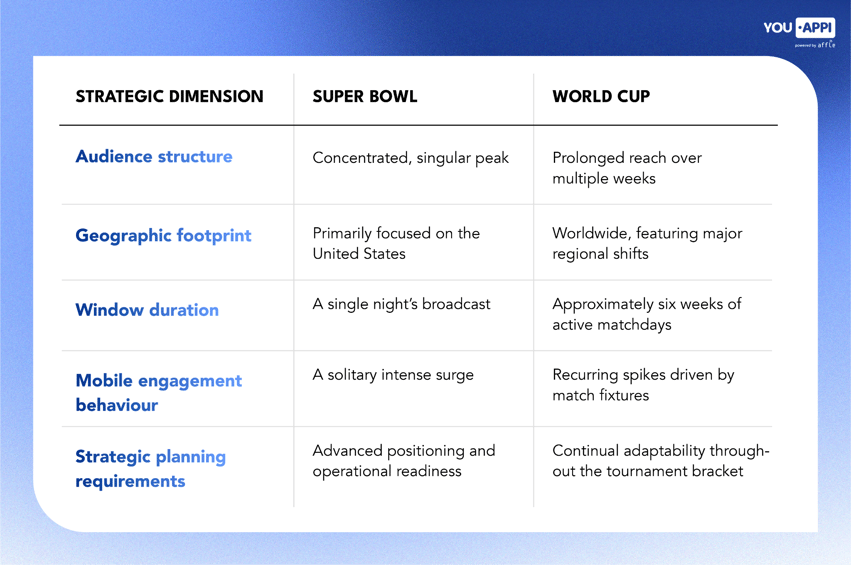
The 2026 tournament alters this geographical dynamic in a way that aligns with a North American perspective. With the competition jointly hosted across the United States, Canada, and Mexico, a traditionally global phenomenon transforms into a domestic event for the same territory that anchors the Super Bowl. This divergence between American and international user groups was already evident in 2022, when Sensor Tower reported that UK-centric sportsbook downloads grew by approximately 200 percent, compared to an 83 percent increase among the US audience. By 2026, these distinct fan bases will converge geographically on the same continent for the first time.
What the Install Numbers Leave Out
Almost every figure cited so far describes installs and new users. That framing is incomplete, because it treats a live sports event as a user acquisition moment and stops there. The more durable opportunity sits one layer down, in the existing base that the event reactivates.
A tournament does not merely create new users. It reactivates dormant ones, saturates active applications with high-intent sessions, and assembles audiences whose heightened engagement carries a known and short duration. The brands that derive the most value are not necessarily those that acquired the most installs during the opening week.
They are the brands that retained those users beyond the final whistle, and that re-engaged the lapsed players, viewers, and bettors the event drew back into the app. YouAppi has mapped this dynamic for gaming specifically, dividing the tournament into three distinct re-engagement windows for publishers.
The influx is the visible outcome; what becomes of those users after the final whistle is where return is ultimately decided.
At this point the seasonal logic inverts. Acquisition campaigns capture the audience as it arrives, whereas retargeting determines whether that audience leaves any lasting value once the schedule empties and the next tournament is four years away. For categories that experience pronounced churn after a tentpole event, gaming foremost among them, retention is not subordinate to acquisition. It is the variable that determines whether the investment compounded or merely registered as a momentary increase.
Maximizing Value: Retaining Users Post-Spike
Retargeting provides a dedicated framework for this critical window, analyzing user behavior in real time and delivering tailored creative aimed at returning users to the app rather than acquiring them from scratch. Leveraging over a decade of mobile audience expertise—with 80 percent of that effort focused in gaming—YouAppi's tournament analysis demonstrated that rebuilding creative specifically for re-engagement yielded a 125 percent increase in ROI while maintaining the exact same audience and budget.
This operational dynamic holds true across both sporting spectacles: live events capture immediate attention, mobile screens absorb it, and lasting value compounds for whoever successfully re-engages those audiences before interest fades.
Before structuring your next event-driven campaign, review how YouAppi re-engaged lapsed players at scale in the Murka Games case study.