



A first impression carries different weight depending on where a user sits in the funnel. In acquisition, the ad itself functions as that first moment, deciding whether the user installs or not. In retargeting, the user has already installed the application, and the ad's task shifts from earning a decision to re-establishing one already made.
Adjust raised a related point about first impressions in a recent piece on link aesthetics: everything a user encounters during the redirect, not just the ad, shapes whether it feels trustworthy. This piece, produced in partnership with Adjust, extends that argument into retargeting and assumes deep linking already exists; for the basics, see our deep linking fundamentals piece.
Two Stages of Deep Linking, and What Each One Costs
Stage 1: A Deep Link to the App
Not every campaign has reached this baseline yet. Without any deep link at all, an ad click sends the user to the app store instead of the app itself, whether or not it is already installed.
If the app is already installed, the user still has to find it in the store and tap Open, an extra step that was never necessary. If it has not been opened recently, the store may need to re-download it first, and that wait is often where attention is lost entirely.
A basic deep link changes that. Clicking the ad opens the app directly, skipping the store detour entirely and improving open rates on its own, even before the destination inside the app is addressed. For a closer look at implementing this layer, see our guide to deep linking fundamentals.
Adjust distinguishes direct deep links, which open the app straight to a specific screen when it is already installed, from deferred links, which route new users through an install first. Retargeting operates almost entirely in the first category: the objective is not acquisition, but the frictionless return of an existing user to a specific level, offer, or cart.
Stage 2: A Deep Link to the Exact Moment
This is where this article's argument lives: sending the user not just into the app, but to the exact moment the ad references. In gaming, that often means returning a lapsed player to the exact point in a level where they left off, rather than the title screen.
The same logic extends to other retargeting segments (grouped by engagement level, not by vertical): a dormant high-value user retargeted with a limited-time offer should land on that offer page, not a page describing it. Each segment depends on the deep link destination matching the promise made in the ad.
Stopping at Stage 1 rarely looks like a problem on the surface. Inside a live campaign, though, three things tend to happen at once.
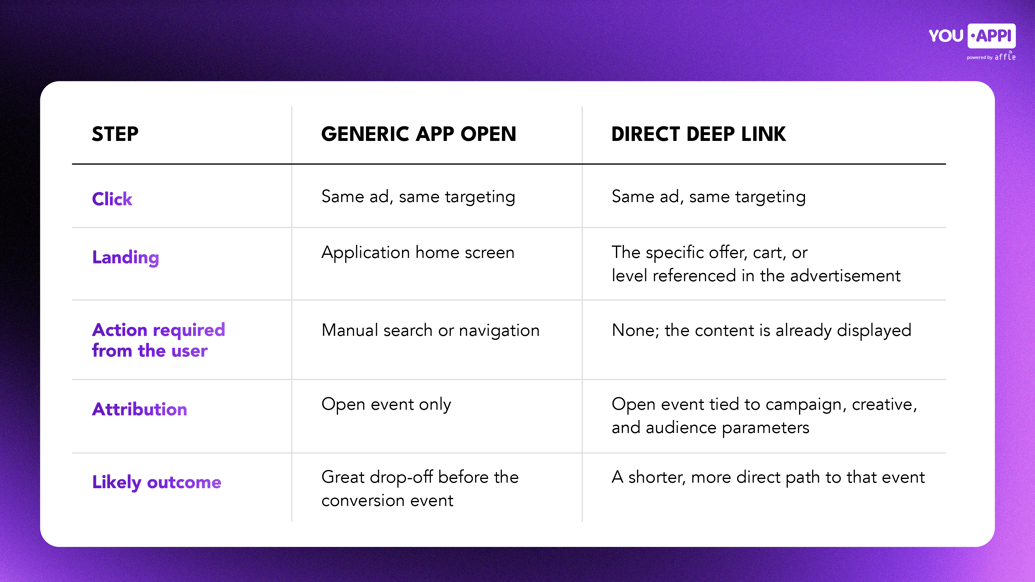
- The user arrives at the home screen rather than the intended moment. A user unable to quickly locate the content that prompted the return is considerably more likely to close the application than to navigate toward it manually, particularly given the already fragile intent behind a re-engagement click.
- Attribution loses precision. Without a deep link carrying campaign parameters into the open event, the platform managing the campaign encounters greater difficulty attributing that specific return to the audience, creative, and bid responsible for it.
- Spend stops producing evidence. A click that does not resolve into a clean in-app landing has still incurred cost. It simply stops showing what that expenditure achieved, which renders optimization decisions further down the funnel less reliable.
Laid out side by side, the two paths look like this:
None of this shows up as an obvious outage. There is no error message, no downtime, no signal that triggers an alert. The campaign simply underperforms relative to what the targeting and creative alone would predict, and that shortfall is easily misattributed to audience quality or bidding strategy instead.
The Redirect as Part of the Experience
A storefront sets expectations before a shopper enters the building; a link performs the same function before a user opens the app. A clean, branded link communicates intentionality, while an unfamiliar one introduces doubt before the user clicks through.
"In retail, you invest in the storefront because you know it drives footfall. Your link is the digital equivalent; a split-second first impression that either earns a click or loses it. Every messy URL is a quiet tax on your campaign's performance." - Karthik Kannan, Lead Product Engineer, Adjust.
For an acquisition ad, this shapes a first decision. For a retargeting ad, the user has already decided once before, and the redirect is what confirms or breaks that continuity in the moment it matters most.
Evidence From an Active Retargeting Campaign
Adjust's guidance describes the intended behavior at the link level. The practical expression of that guidance within a live retargeting campaign is more evident through an applied case.
On Murka Games' Slots Era campaign for iOS, the deep link opens contributed to attribution accuracy under a multi-layered, probabilistic targeting approach. The campaign produced a 300% increase in targetable audience size, a 70% lift in D7 ROI, and a 30% reduction in eCPO.
The underlying mechanism is straightforward: MMPs attribute a conversion accurately when a deep link, rather than a generic app open, brings the user back into the application. In a post-ATT environment, fewer deterministic signals are available at the outset, so that accuracy has fewer alternative sources.
This does not suggest that the deep link produced the result independently. It functions less as the central factor and more as the condition the rest of the outcome depends on. Cleaner attribution feeds segmentation, bidding, and reporting with better data at every stage.
For more on how the campaign was structured, see YouAppi’s Murka Games case study.
The Deep Link as the Starting Point for Performance
Retargeting campaigns are ultimately evaluated on what happens after the click, not before it. Adjust's work on link presentation and YouAppi's retargeting infrastructure converge at precisely that point: a link that opens directly to the correct in-app moment, attributed cleanly, for a user who has already installed the application once.
None of this requires additional budget or a revised audience strategy, only treating the link as an integral component of the campaign rather than as infrastructure configured once and then overlooked.
Before the next re-engagement campaign launches, three elements merit verification:
- Whether the tracking link is configured as a direct deep link rather than a generic open
- Whether the in-app destination matches the specific offer or moment referenced in the creative
- Whether the MMP is receiving clean attribution data from that open event
To see how a properly attributed deep link configuration performs inside an active campaign, talk to YouAppi's team about auditing the deep link setup across your next managed retargeting campaign. For the measurement side, consult the Adjust team about TrueLink.