


Most holiday plans are organized around four quarters that conclude on Christmas Day. By late December the forecasts have been met or missed, the season is treated as closed, and planning attention shifts to the year ahead. A fifth window follows nonetheless, one the four-quarter calendar does not formally recognize, running from the day after Christmas into mid-January, and it delivers a buyer the preceding four quarters did not reach.
This piece defines that window, examines who arrives within it, and sets out where it belongs in a plan a brand already operates.
The Quarter Between Q4 and Q1
Q5 is the unofficial fifth quarter of the year, the short span that bridges the end of the holiday season and the start of Q1. The name comes from media buying rather than the fiscal calendar: planners who kept spending after Christmas observed that the stretch behaved like a quarter of its own, and began to call it Q5, the window from roughly December 26 to the middle of January, after the official season closes and before first-quarter budgets come online.
Its importance rests on a rare combination: demand that remains elevated while competition has stepped away. Shoppers are still spending, still installing, and still deciding what to do with what they received, at the same moment most advertisers have closed their books for the year. High intent meeting low competition is the condition every performance marketer looks for, and in these weeks it appears by default.
Who Shows Up After the Season Ends
The shoppers who fill this window are not, for the most part, the buyers a brand already has. In the United States, where device gifting is concentrated, Q5 is when a new audience forms on its own, driven by three forces that all peak after the sale.
New devices. A gifted phone is a blank device, and its first days are the most install-heavy a user will have all year, with global mobile game downloads reaching 4.2 billion in January 2026, up 5.4 percent over December.Gift cards. A card received in December is a purchase deferred rather than skipped, and a meaningful share of redemptions land after the sale, through January.
Post-holiday intent at scale. Adjust ranked January among the strongest months of the first half of 2026, with installs roughly 4 percent and sessions roughly 5 percent above the half-year average.
What Q5 Looks Like Inside a Mobile App
For a mobile application, this audience does not announce itself as a campaign result. It arrives as a surge of fresh installs on new hardware, concentrated in the days when a device is new and its owner is still populating it. Most of that volume is organic rather than bought: across shopping apps in H1 2026, organic installs outnumbered paid ones by roughly four to three, so a large share of the Q5 wave is demand no advertiser bid for.
That first session is both the peak of the relationship and the start of its sharpest decline. New users are most active on the day of install, but by the following day most have lapsed: day 1 retention across e-commerce apps held at just 13 percent in H1 2026, fewer than one in seven returning. The window to convert a January installer into a returning user is therefore measured in hours, not weeks.
That compression is what makes Q5 a re-engagement problem for mobile rather than an acquisition one. The install has already occurred, frequently without a bid, and the open question is whether the first session becomes a second. Reaching that user with a deep-linked, behavior-aware message while intent remains live is the work the window rewards, and it is the work most plans have no budget positioned to perform in January.
Where Q5 Fits in a Plan You Already Have
Acting on Q5 does not require a new strategy, a point most teams overlook. It requires extending one that most brands already run during the fourth quarter.
Two earlier pieces in this series established the groundwork. The efficient-spend case argued that the audience a brand already owns is its most efficient source of return when media gets expensive, and the post-sale retention piece showed how to keep holiday buyers moving toward a second purchase. Q5 extends the same machinery to a group neither piece covered: the users the season delivers without a bid.
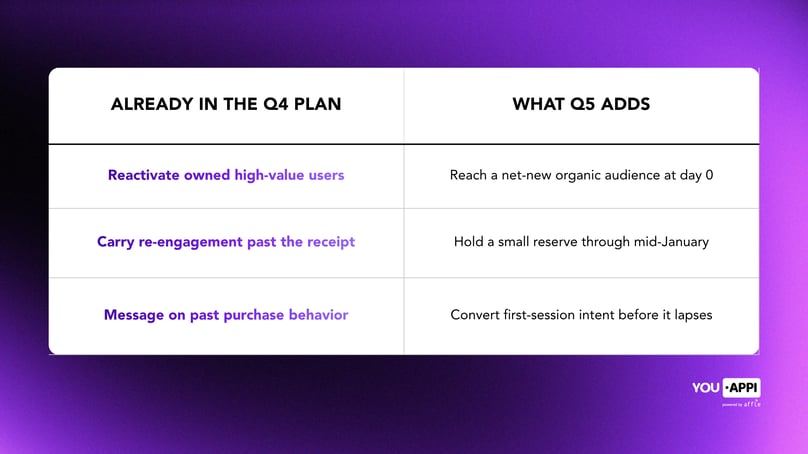
The re-engagement works best when it reads the user rather than the calendar. A day-0 installer responds to a message tied to what they just did, and churn type should shape that message rather than a flat prompt to return.
Put Q5 on the Calendar
The shopping season has a fifth quarter, and it opens the day most teams consider the first four concluded. A wave of brand-new, high-intent users arrives through mid-January, the auction is briefly thin, and the only thing standing between that opening and the plan is a line item that was zeroed out in December.
Naming the window is most of the work. Once Q5 is on the calendar, the cost of acting on it is minimal: a small reserve carried past the receipt, pointed at the users the season delivers on its own, running the same re-engagement engine the fourth quarter already proved.
Map what a timed Q5 reserve would add to the plan you already run, with the YouAppi team →